CEO

Achieving CMMC certification can create new insurance and contract obligations that last long after your defense contract ends. These requirements may become a permanent part of how your business is evaluated by insurers and vendors.
Most businesses assume CMMC compliance is a box checked once for a single defense contract, then forgotten. In practice, the certification work outlives the contract itself, following a business into insurance renewals and vendor negotiations for years afterward.
That insight matters because insurers and future partners often evaluate a business by the standards it already proved it could meet. The obligation doesn't expire when the Department of Defense (DoD) contract does; it can shape what a business owes to others long after.
CMMC, or Cybersecurity Maturity Model Certification, exists to protect sensitive government data, and it does so by setting tiered security requirements that contractors must satisfy to handle controlled unclassified information and federal contract information. The original goal is straightforward: qualify for DoD work. Yet the changes made along the way to reach that goal tend to reshape a business's risk profile well outside the defense world.
Because that reshaping is easy to miss, it's worth tracing out before it causes a surprise at renewal time or mid-negotiation with a new vendor. The sections below walk through where these effects show up and what to watch for.

Earning CMMC certification means more than satisfying a government checklist. Insurers read the underlying work - the NIST SP 800-171 controls put in place, the system security plan documented along the way - as evidence of a business that takes cybersecurity seriously.
That evidence can work in a business's favor: some insurers respond to a stronger risk profile with better terms or lower premiums. The advantage comes with a catch, though. Once a business has proven it can meet CMMC requirements, insurers tend to expect those standards to hold, DoD work or not.
Let the controls slip, or let the cybersecurity maturity model certification lapse, and coverage terms can shift in response. Insurers may add exclusions, raise premiums and cite the added risk as justification, and in some cases they'll ask for proof that the CMMC program is still active before they'll renew the policy at all.
The result is a new baseline. Once compliance is achieved, it becomes the standard insurers measure a business against, and that standard outlasts the contract that created it.
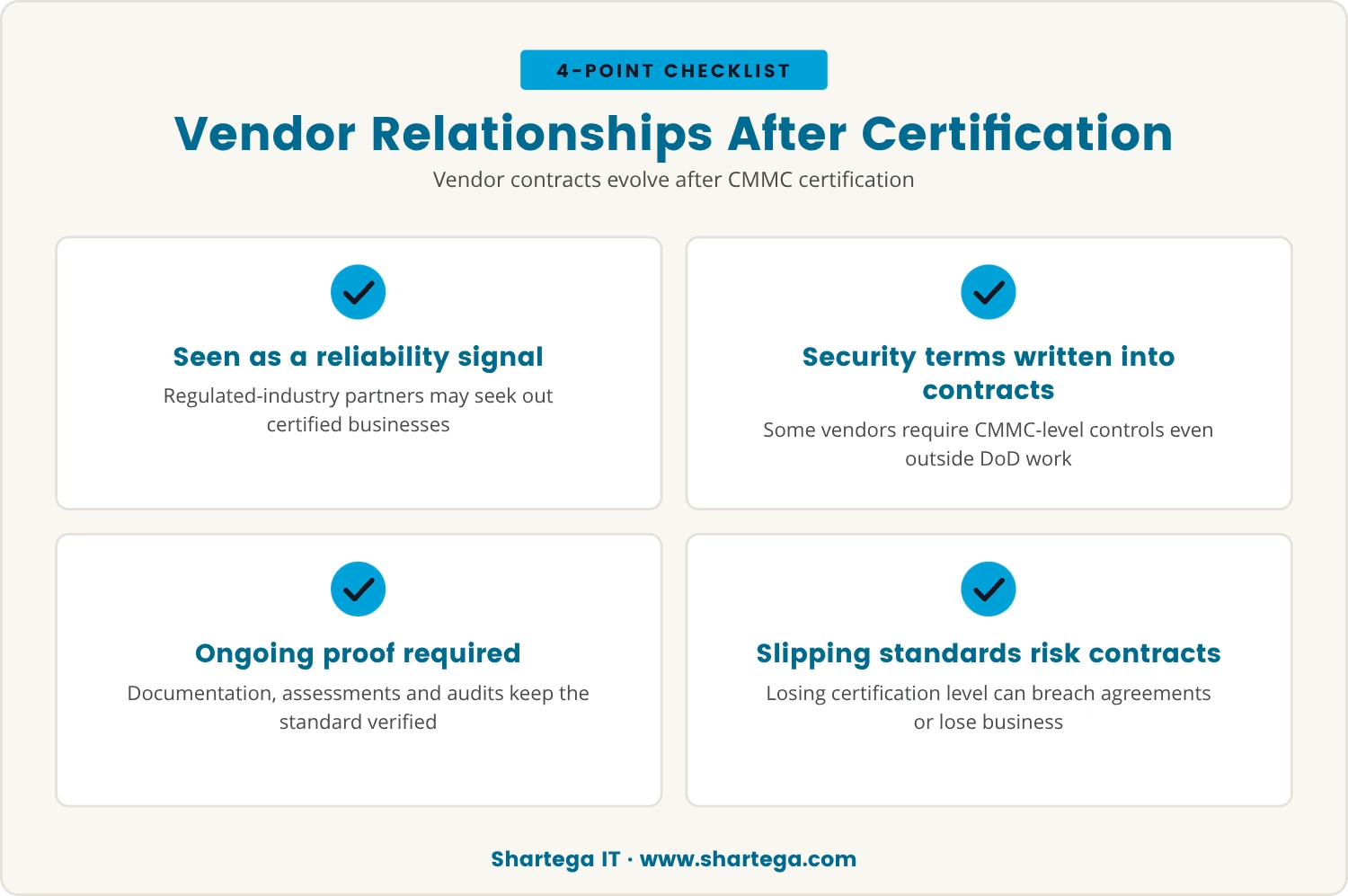
Insurers aren't the only ones recalibrating; vendor relationships shift too once CMMC certification is in hand. Other businesses, particularly those in regulated industries, tend to read that certification as a signal of reliability, which makes them more likely to seek out the certified business as a partner and expect the same security standard on their own projects.
That expectation has a way of turning into a new obligation. Some vendors write CMMC-level security requirements directly into contracts, even for work that has nothing to do with the DoD, and they may ask for regular proof that the same controls built for the defense contract are still in force.
Meeting that ask means keeping up with documentation, assessments, and sometimes third-party audits - real, ongoing work. Let the CMMC level slide, and the risk isn't just reputational: it can mean breaching those newer contracts, with penalties or lost business on the other side.
So certification status doesn't stay confined to the contract that earned it. It becomes part of how vendors see and work with the business going forward.
For businesses in Chicago, these effects reach past the local defense industrial base. The city's varied business environment means vendors and insurers outside federal contracting may still recognize the value of the certification and factor it into their own decisions.
That recognition cuts both ways. Chicago-area companies that have reached CMMC level 2 or higher often find their security practices becoming a reference point in later deals - an advantage, but one that comes paired with new expectations. A business partway through pursuing CMMC, or one that has just cleared an assessment, might ask: are current insurance and vendor agreements already tied to that certification status?
The answer shapes how ongoing compliance gets managed from here. Dropping security controls or letting documentation lapse doesn't just affect government work - it can ripple into every other business relationship built on that same reputation.
Certification isn't the finish line. The work done to meet the requirements - updating the system security plan, completing a plan of action and milestones - tends to become part of how a business operates day to day. The areas below break down where that ongoing effect shows up.
Once a business has shown it can meet CMMC requirements, insurers tend to expect those controls to stay in place. Letting them slip can change the risk rating at renewal.
Vendors may write clauses into contracts requiring the CMMC level to be maintained, even on projects that have nothing to do with defense work.
The habits and processes built to reach CMMC often settle into standard practice, which raises what both team and partners come to expect.
Some partners will ask for ongoing third-party assessments to confirm the security controls behind the original certification are still holding.
CMMC certification can become a genuine selling point, but that same visibility means competitors and clients will expect the standard to be maintained.
Insurers and vendors, not just the DoD, may start requiring regular updates to the system security plan and related documents.
CMMC 2.0 simplified the path to certification for some businesses while quietly raising the bar on what ongoing compliance looks like. With three clearer levels and more defined requirements, insurers and vendors now find it easier to point directly to those standards in their own underwriting and contracting processes.
That wider recognition cuts both ways. As the CMMC program becomes a familiar reference point, the security posture behind a certification tends to become a permanent fixture of a business's reputation - a benefit, but one that carries long-term costs and obligations attached to keeping that status current.
For a defense contractor, or even a business just adjacent to that world, understanding this is what keeps the lasting effects from becoming a surprise. Passing the assessment is only the start; managing the expectations that follow is the part that continues.
Whether certification is still ahead or already achieved, the long haul deserves a plan. Start with the paperwork already in hand: review insurance policies and vendor contracts for any mention of certification status, and talk with legal and compliance teams about what happens if that status changes.
From there, build regular reviews of security controls and documentation into standard business processes, which makes it easier to stay ahead of new requirements as insurers or vendors introduce them. Keeping the team current on CMMC requirements matters just as much, so shifting expectations don't arrive as a surprise.
The effects of CMMC compliance tend to reach further than expected, but that reach cuts both ways. Planned for early enough, these same obligations become an advantage - making the business more resilient and more attractive to the partners it hopes to keep.

Many businesses with 20 to 300 users, especially those in auto dealerships or similar fields, find themselves navigating new insurance and contract demands after achieving CMMC certification. At Shartega IT, we understand how these ongoing obligations can impact your operations and planning.
If you want to see how we help clients manage the long-term effects of CMMC compliance, or if you’d like to discuss your own setup, we invite you to start a conversation with our team.
Sign up with Shartega and get your first 2 months free—an easy way to start managing your ongoing CMMC-related obligations with expert support.
Even after a DoD contract ends, the controls and documentation built for CMMC certification continue shaping how insurers and vendors view the business. Many expect those standards to hold, and insurance or vendor contracts may require ongoing proof of compliance.
Yes. Insurance providers may adjust premiums or policy terms if the security requirements present during the CMMC assessment are no longer being met, treating the business as higher risk once those controls lapse.
CMMC level 1 covers basic cybersecurity requirements, while level 2 adds more advanced controls and documentation. A business that reaches level 2 can expect insurers and vendors to hold it to that higher standard even after defense work ends.
Not always. The initial CMMC assessment typically requires a third-party assessment organization, but later contracts often need only proof that controls are being maintained. Some vendors or insurers, however, may still request updated third-party assessments to confirm ongoing compliance.
Review current contracts and insurance policies for any language referencing CMMC requirements, and build regular reviews and updates of security controls into standard business processes. Keeping documentation current is the proactive step that makes long-term obligations easier to manage.


