CEO
Businesses that rely only on technical defenses can still violate the GLBA Safeguards Rule due to ordinary habits they never considered a risk. Non-technical routines often create compliance gaps that technology alone cannot fix.
A firewall going down costs money to fix. A habit going unnoticed costs far more: regulators treat careless routines the same as a hacked server, and the GLBA Safeguards Rule was written with exactly that in mind.
Firewalls and antivirus software handle the technical side of security, but the rule was never only about technical barriers. Ordinary habits that feel harmless on a busy day can still leave a company out of compliance, and when that happens, the consequences have nothing to do with hackers or malware.
The GLBA Safeguards Rule protects customer information handled by financial institutions, a category that includes auto dealerships and many other businesses beyond banks. It requires a comprehensive information security program, which means the rule looks past technology alone and into how everyday business practices affect the confidentiality and integrity of customer data.
Given that broader scope, many organizations still aim their attention at technical solutions and miss the less obvious ways daily routines create vulnerabilities. Those overlooked habits can lead to violations even when IT systems are fully up to date, which is exactly why understanding them matters for anyone responsible for GLBA compliance.

Many businesses in Chicago and beyond invest heavily in cybersecurity tools, trusting that the investment alone keeps them compliant. Technical controls are necessary, but they cover only part of the picture, since the GLBA Safeguards Rule requires attention to both technical and non-technical risks.
Compliance is not just about technology. The rule expects oversight of how people handle information, not only how systems protect it — a strong firewall, after all, cannot stop an employee from mishandling sensitive paperwork or sharing a password.
Focusing exclusively on technical defenses means missing the human and procedural factors that actually cause violations: how staff access customer information, how documents get stored, how vendors are managed. Each of these areas introduces its own risk when left uncontrolled.
Regulators, for their part, assess the overall approach to protecting customer data, so gaps created by daily habits go uncovered no matter how strong the technology is behind them. That is why a balanced approach, not a purely technical one, is essential for genuine GLBA compliance.
Even well-built IT systems sit alongside ordinary habits that can pull a business out of compliance without anyone noticing. Five practices in particular tend to go unnoticed:
Letting several employees use one shared login feels convenient, but it quietly defeats access controls. The GLBA Safeguards Rule expects a clear record of who accessed customer information, and shared credentials erase that record entirely.
Stacks of documents left on desks or in unlocked cabinets expose nonpublic personal information to anyone who walks by. Physical security carries the same weight as digital security under the rule.
Once employees access customer data on their own phones or laptops, control over how that information is protected slips away. Personal devices often lack proper security settings, which raises the odds of a data breach.
Outside vendors handle services like payroll or IT support for many businesses, and skipping an assessment of how those vendors protect data leaves a gap. If something goes wrong on their end, the business can still be held responsible.
Tossing old files or deleting digital records without secure methods opens the door to unauthorized access after the fact. The rule's protection extends across the entire lifecycle of customer information, disposal included.
Routine document handling ranks among the most overlooked sources of risk, since printing, copying, and storing sensitive information is simply part of daily work for many employees. Left unmanaged, those documents can be lost, stolen, or seen by people who have no business seeing them.
A customer application forgotten on a printer or a file cabinet left unlocked are small moments, but small moments add up, and enough of them accumulate into a breach that draws regulatory scrutiny.
A single careless moment can compromise confidentiality. Training staff on proper handling and setting clear policies for storage and disposal address that directly, while regular checks and reminders keep the habits aligned with what compliance actually requires.
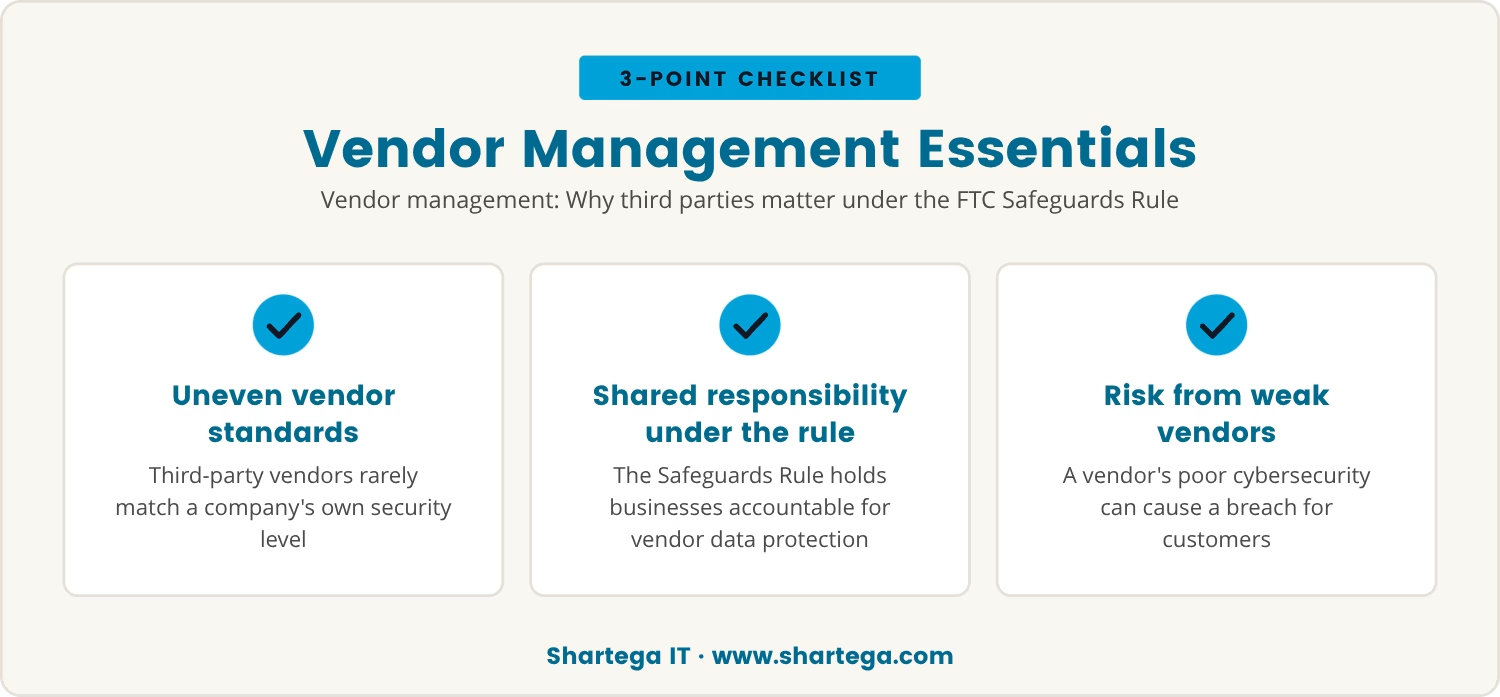
Critical services often run through third-party vendors, yet those vendors rarely meet identical security standards. The FTC Safeguards Rule nonetheless holds a business responsible for making sure its service providers protect customer data as carefully as it does itself.
Skipping the assessment and monitoring of those vendors means absorbing risks that sit outside direct control — a payroll provider with weak cybersecurity, for instance, can become the source of a breach that lands on a company's own customers. Regulators weigh exactly this due-diligence process when they evaluate compliance.
Vendor management is not a one-time task. Reviewing contracts, requesting evidence of security practices, and requiring vendors to report incidents all need to happen on an ongoing basis, which is precisely what makes this oversight a core part of a comprehensive information security program.
Routines that look harmless can lead directly to a data breach. A weak password, or one written down where a passerby can read it, makes unauthorized access far more likely, and neglecting software updates on personal devices used for work opens the same kind of door.
A breach does not always start with an outside attacker; more often it builds from small oversights that pile up over time, and regulators draw no distinction between a breach caused by hackers and one caused by poor habits — both carry penalties and both cost trust.
Everyday actions matter as much as technical controls. Regular training, clear policies, and ongoing monitoring are what keep these routine mistakes from turning into costly incidents.
Protecting customer information works best as a shared responsibility, understood by every employee rather than left to IT or management alone.
Together, these steps turn compliance from a checklist into a daily habit, and once everyone understands the risks, the pitfalls that lead to violations become far easier to avoid.
Technology investment feels like the whole solution, but the real risk usually lives in what people do every day. Habits that seem minor, like sharing a password or leaving files unsecured, cause violations that no amount of technology can prevent.
The GLBA Safeguards Rule expects the whole picture, not just the technical slice of it, and a business that focuses only on technical defenses misses the ordinary routines putting it at risk. Paying attention to those habits protects more than a compliance status — it protects reputation and the trust customers place in the business.

At Shartega IT, we know that businesses with 20 to 300 users often focus on technology but may not realize how daily routines can impact compliance. Even with reliable systems, ordinary habits can create unexpected risks.
We invite you to see how we help businesses like yours in Chicago identify and address these hidden compliance gaps. Let’s talk about your current setup and how small changes could make a big difference.
Sign up with Shartega and get your first 2 months free—an easy way for qualifying businesses to start closing compliance gaps with expert support.
Technical safeguards are the tools and systems used to protect data, such as firewalls, encryption, and access controls. Non-technical safeguards are the policies, training, and daily habits that guide how people handle information, and the Gramm-Leach-Bliley Act requires both for full compliance.
A company handling personal financial information — an auto dealership or a business offering loans, for example — likely counts as a financial institution under the rule. Reviewing the official definition or consulting a compliance expert is the surest way to confirm it.
Access controls include limiting who can view or edit sensitive data, assigning unique logins to each employee, and requiring multi-factor authentication for critical systems. Together these controls block unauthorized access to customer data.
An information security program deserves review at least annually, and sooner whenever a significant change hits the business or its technology. Regular reviews surface new risks and keep safeguards current.
An incident response plan should kick in immediately once a breach happens, with affected customers and the appropriate authorities notified as the law requires. From there, investigating how the breach occurred and updating policies and training helps prevent a repeat.


